Are you the pack leader?

Recently I created a Pack Leader quiz as a fun way to assess where people fit in to their pack with just a few easy questions. The quiz was very simple and generalized but the questions I chose were specific to things that communicate to your dog whether or not you are the leader of your pack. Not surprisingly, many people were revealed as follower and not leader. I figured this was a great opportunity to write a blog to help people understand the little things they do that make them a follower and how they can redeem their role as leader.

Pack leader or follower

So what does it mean to be the pack leader exactly? Being pack leader means providing guidance and setting your dog up for success by taking away the stress of having to take the front position of the pack. In a pack there are only 2 positions: leader and follower. Dogs, like humans, are pack animals but unlike us, dogs will not follow an unbalanced leader. Dogs are drawn to calm assertive energy as their leader. Calm assertion means being even-tempered, confident and in control. If that energy is not present in the owner the dog will step in to control the situation even if it is unnatural for them. This is typically when we see behavioural issues develop like aggression, destructiveness, and anxiety among others, because a dog without leadership is unbalanced. The dog sees the human as a weak energy state making him lower on the totem pole towards the back of the pack so the dog will do what is necessary to fulfill her needs.

Here are the things to consider when it comes to being pack leader… 

1) A pack leader is calm assertive, never emotional, nervous or excited. The mother when giving birth to her litter is calm assertive and this is the first energy they experience. It is important for the human pack leader to have this same demeanour.

2) A pack leader provides direction and protection and fulfills his packs needs with exercise, discipline and then affection. A pack leader doesn’t just give love all the time. They provide structure and an outlet for energy first and foremost. It’s just like parents with children, they must do their homework (discipline) before they can go out side and play (reward).

3) A pack leader is always in control. He makes all decisions. He decides where to go, when to go, when to eat, and when to sleep. He starts and stops all activities. He doesn’t ask, “are you ok with my decision?” He just expects that his pack will follow. If your dog chooses when to play, walk, eat or wake up, then he is pack leader.

4) A pack leader is always consistent. If he does not continually uphold the rules, boundaries and limitations, then the other dogs will begin to test them. If you are only leader 80% of the time then your dog will only follow 80%. Being pack leader means providing guidelines 100% of the time.

pack leader quiz results

It’s never too late to start to implement these pack leader strategies to ensure the health and happiness of your pack. If you are experiencing any behavioural issues perhaps take a look at how you are with your dog and whether or not you’ve allowed him to be the pack leader. If you are unsure, take my quiz. Just remember, lead and your dog will follow.

Walk this way

dog on leashHave you ever noticed that the sign for “dogs must be on leash” is an illustration showing a dog in front of the owner with tension on the leash? A woman I met at the Cesar Millan training workshop pointed this out to me and then handed me a stack of stickers with the illustration of a dog with a loose leash walking BEHIND the owner. Brilliant I thought! The idea is to change people’s perspective on how we walk dogs by placing a sticker over each sign you see. This novel idea will take a huge movement and mean a lot of reeducation for owners.

Every day I see people on walks with their dog pulling on a tight leash ahead. When walking like this the dog sees himself as pack leader and this is when problems arise. Not only that, a dog greeting another dog on a tight leash is when you see the most dog fights happen. It is unnatural for dogs to meet face to face, and when a leash has tension and the dog pulls, their body language suggests a challenge to the other dog which then leads to aggression.

How you and your dog walk together says a lot about your relationship.

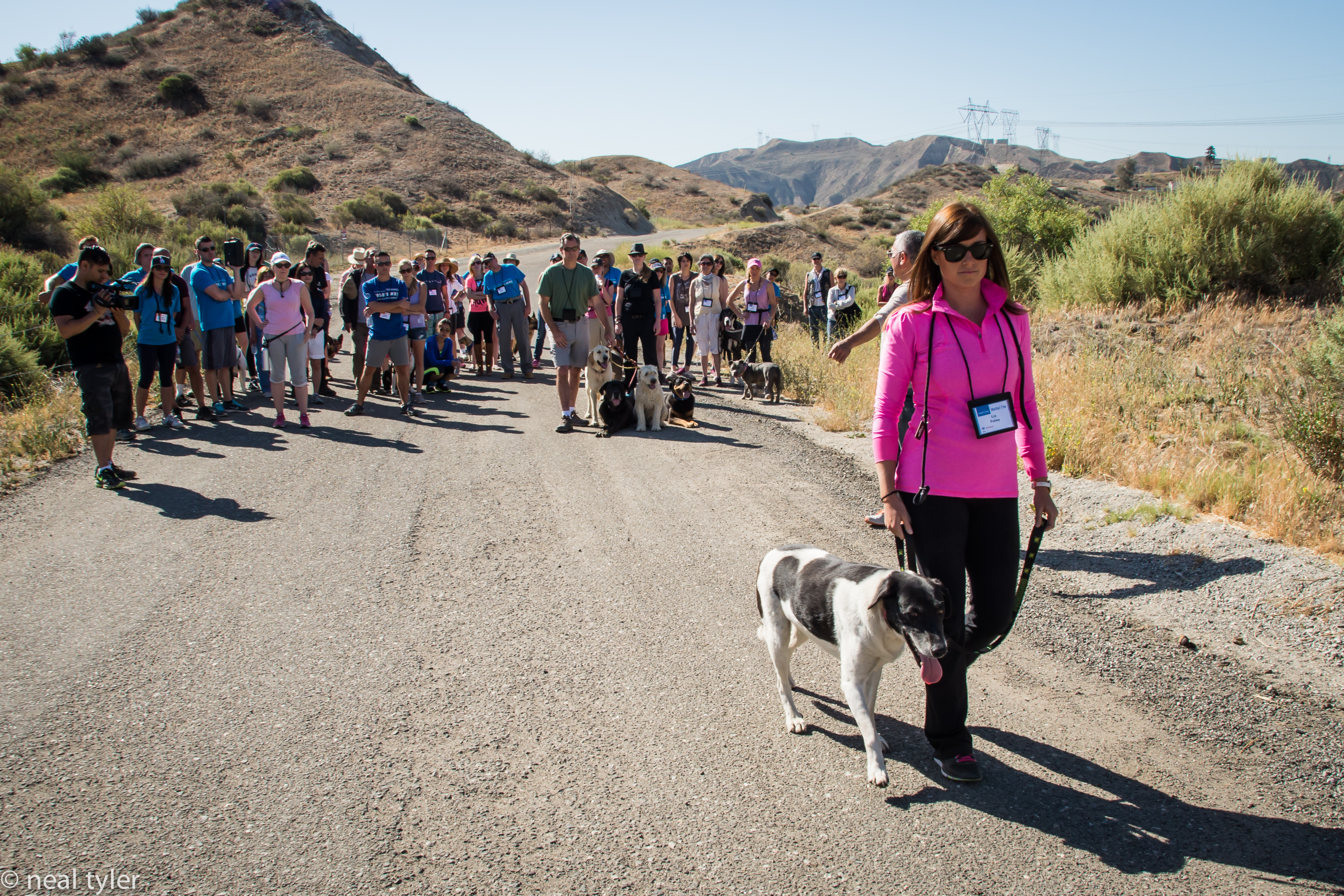
Each morning while training at the Dog Psychology Center, we started with a pack walk. Cesar Millan’s first rule for a balanced dog is exercise, then discipline and then affection – and he stresses that it must be done in that order. While walking each day I learned that the walk is just as much for you as it is for your dog. It allows you to clear your mind, exert pent up energy and balance yourself and your dog. I have always loved walking with Carmen and she does so well on leash, but I have found a whole new appreciation for it. At the end of our walks it feels as if I spent an hour in a yoga class or getting a massage, I am that relaxed. If only we could all experience this. Unfortunately not all dog lovers enjoy walks the way I do, even more unfortunate, some people don’t walk their dogs everyday or even at all.

TCW DAY 1-118

I believe that how you and your dog walk together says a lot about your relationship. If your dog charges ahead, then you are not in control enough to be the leader. If your dog drags behind or refuses to walk, again your energy is off in order to lead the pack. If you think about it our dogs are here to show us how simple life can truly be in this regard. We are too hung up on rushing things, doing everything quickly, multitasking, and not enjoying the little gifts this world has to offer. Next time your on a walk take a deep breath, relax your shoulders, and go slow. Make sure your dog is beside or behind you with no tension on the leash. You and your dog will enjoy the walk way more.

Well mannered pooches don’t jump up

maverick

A perfect greeting. Photo by Liz Foley

Keeping your dog’s four feet on the ground is important for greetings, whether meeting humans or other dogs. It is a common misconception that an excited dog jumps up. People often think that their dog is just happy to see them or trying to hug them. The truth is, the dog is asserting himself over his owner. Jumping up is a sign of dominance. I’ve often seen my dog discipline young pups who come barrelling at her with paws all over the place. A dog that runs up and places paws on her face or back without first allowing for a proper handshake (smelling each other as a way to say hello) is flat out rude. Dogs must first be invited into the personal space of others. You wouldn’t just run up and tackle someone you were meeting for the first time, would you?

Dogs whether big or small need to learn that greetings do not mean jumping up. Large dogs can knock children or the elderly right off their feet doing serious damage. Small dogs need not be excused either, their little nails can easily break skin. I have heard of many of these “excited, happy dogs” greeting people inappropriately and quickly being called aggressive because of the hurt they have caused

1891519_10101526654419681_982936190_o

Carmen and her friend Bernie waiting to greet nicely.

What can you do to teach your dog to greet properly? If you know your dog is going to jump up, make sure they are on leash before greeting people or pets. Interrupt the behaviour before it happens by keeping your dog calm and placing him in a sit. Practice greetings with dogs and people you know who are willing to work with you. If your dog goes to jump, pull back quickly to prevent making contact, place him back into a sit, and try again when he is calmer. Ask people to not acknowledge your dog until the dog is calm. Petting the dog after he or she has just jumped up is rewarding the behaviour. With patience and consistency, your dog will learn that he only gets to meet once he is settled with all four paws on the floor and will be rewarded for it. The more dogs and people your dog meets the more opportunities you have to correct the behaviour.

If your dog jumps up on you, you can still use the leash trick but instead stand on the leash preventing the dog from jumping up in the first place. Dogs are quick learners and just need guidance. We must teach them how to properly greet everyone before we can expect them to do it right. Set expectations for your dog and keep them.

Fireworks, thunderstorms, and loud noises, oh my!

The best defence is a good offence. This awesome piece of advice believe it or not works wonders with dogs, especially those who are anxious around loud noises. Being able to predict what your dog is going to do before he does it, like how he may react to a sudden BOOM, will help to curb the behaviour. That means being aware of your dog and their surroundings to prevent negative behaviours so that you don’t have to correct them. Always be 10 steps ahead of them. Easy enough, right?

Sometimes it is! You may not be able to predict thunderstorms (nor rely on weather reporters for any help) but you can prepare yourself and your dog for when there will be fireworks. On holiday long weekends you can expect there will be fireworks that light up the sky once it’s dark out. The loud noises accompanied by such a beautiful sight can be frightening for your furry friend. Dogs may pace, shake, become destructive, or even run away. No one wants to see their pet in distress, so what exactly can you do?

Fireworks at Disney - Thomas Hawk, Flickr

Fireworks at Disney – Thomas Hawk, Flickr

Keep your dog indoors and whatever you do, fight the urge to caudal your dog! I cannot stress this enough. Petting and telling him, “it’s okay buddy” actually reinforces the dog’s anxious reaction. Instead of comforting him, you are confirming that the dog is reacting appropriately. You have now trained your dog to be frightened of loud noises. Instead, be proactive and exhaust your dog well before the fireworks go off. If your dog usually goes for an hour walk a day, go for a 3 hour hike! Tire your dog out so that he won’t even notice the sounds. During the fireworks it is important that you stay calm yourself. If you are startled by the sounds your dog will think he is supposed to do the same. Dogs pick up very easily on our energy so if you are frightened it will rub off on your dog. Try playing loud music to drown out the sound and distract you both.

Always remember that being proactive helps and you can even prepare your dog for certain situations before they happen. If you have a puppy and you don’t want him to be startled by loud noises, try desensitizing him to the sounds by playing thunderstorms and firework clips off the internet in your own home when he is in a calm, relaxed state. Act normally and if you remain calm your dog will too. Walking your puppy on busy streets where there are buses, cars honking, and kids on skateboards are also ways to socialize your dog and expose them to unpredictable sounds that could spook them later in life if they are not used to them.

Try out these methods this Victoria Day when the fireworks sound. Hope you and your pet have a safe and enjoyable long weekend!