Imagine this, you’re walking your dog down the street and you see someone else approaching with their pooch. Without realizing you tighten up on the leash and reel your dog in. As you get closer you notice the other owner does the same thing, tightly wrapping the leash in a death grip with one hand as his extremely excited dog lunges forward to see yours. As the dogs meet you nervously instruct your pup in a high pitched voice to “be nice.” You stand there and ask the stranger what the dog’s name and breed is while the dogs greet face to face then wrap around getting tangled in each other’s leashes. Suddenly after a few moments there’s a nasty sound and you have to separate the otherwise “friendly” dogs. Embarrassed you abruptly leave, scolding your naughty dog. But what really happened?
Encounters like this aren’t unfamiliar to most dog owners. All too often we unintentionally set the dog up to fail in these situations. We allow our dogs to do the exact opposite of what they should do in proper greetings. We bring the dogs to meet face to face, usually in extremely excited states, with tension on the leash and linger for a long period of time. So let’s take a look at how greetings should be done.
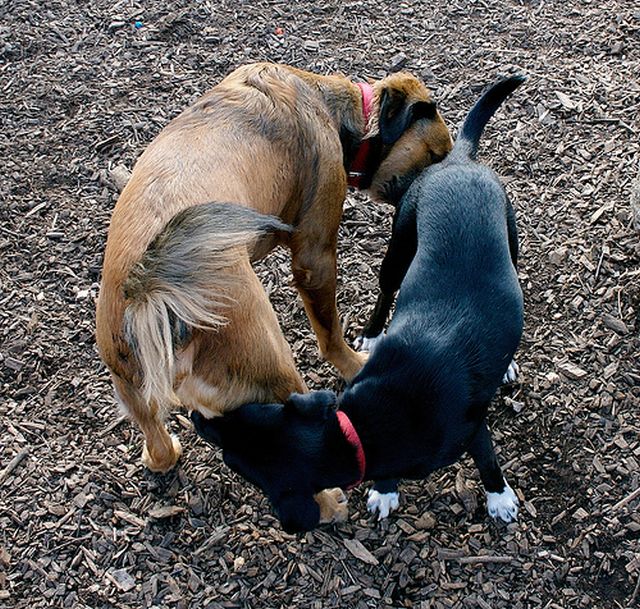
Dogs shake hands by sniffing each other all over and should start from the back and work their way to the front. Sniffing butts isn’t rude, it may not be how we say hello, but to dogs it is completely natural. Allow your dog to briefly smell that area of it’s new acquaintance so that he can gather the information he needs, like age, breed, health, sex, and so on.
Dogs should meet in a calm manner not overly excited or boisterous. When excited dogs meet, they tend to jump up on each other and it usually escalates very quickly to something unpleasant. Even the best of doggie friends can get carried away and clash with over the top greetings. Likewise a dog who is tentative and nervous about meeting another dog will not have a pleasant experience either. Wait until your dog relaxes and do not force him into a situation where he is not sure how to handle himself. Calm and confident is how you want your dog to approach.
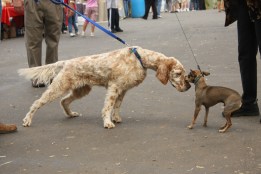 There should never be tension on the leash when dogs are face to face. When the leash is pulled tight, the dog’s body leans forward communicating to the other dog he is staring directly in the face that he wants to challenge. This is when you will get a fight between the dogs. Always keep your dog beside you to keep him out of “protector” mode and so that you can pull sideways not back to remove him from a sticky situation. If there is tension on the leash this communicates to your dog that you are tense so his natural reaction will be to protect. Relax and your dog will too.
Don’t feel the need to stop and say hello to every dog. If for whatever reason you have a bad feeling, keep on walking. Especially if you are working on socializing your dog and greetings are difficult for him make sure you are comfortable with all introductions as it is very important that the dog has good encounters. Be up front with people walking their dogs and speak up on how the dogs should be introduced if you are going to allow them to say hello.
It’s important to not stop for too long and instead to keep moving, dog greetings don’t need to be lengthly. Dogs can smell from a fair distance away so they don’t need to stand around smelling each other for minutes on end. When this happens is when dogs tend to get nasty. It’s like that long awkward hand shake or close-talker at a party that makes you feel uncomfortable. No one likes that, so dogs will react in only one way; because they can’t run away as they are on leash the only other option is to fight. Introductions should be cut short so this doesn’t happen.
Remember that dogs communicate vocally at times so if there is a loud commotion but no one got hurt don’t just assume your dog is aggressive and stop allowing him to say hi. Reflect on the encounter and see what you could have done differently.

 MyDogPhilosophy.com